Deck Terminator
PricingSign inGet started
Presentation resources

Pitch deck examples that separate ideas from evidence

An early-stage pitch does not need invented traction to explain a coherent opportunity. These three fictional teaching decks explore a clinic waitlist tool, a reusable-packaging service and workshop-planning software. Each six-slide example makes its assumptions and next validation steps visible.

Published November 18, 2026

Create your own presentation

Read the evidence sequence

Look for a specific customer, a clear problem hypothesis, a proposed workflow and the uncertainties behind the business model. Then examine the validation plan and the milestone that additional resources would support. The packaging example emphasizes operating costs; the software examples emphasize workflow fit and the purchasing decision.

QueuePilot

A clinic waitlist concept

Fictional teaching example—not a customer case or product-generated result

File language: English · 6 slides · Free download

Download editable PPTX · PPTX

Preview every slide and its purpose

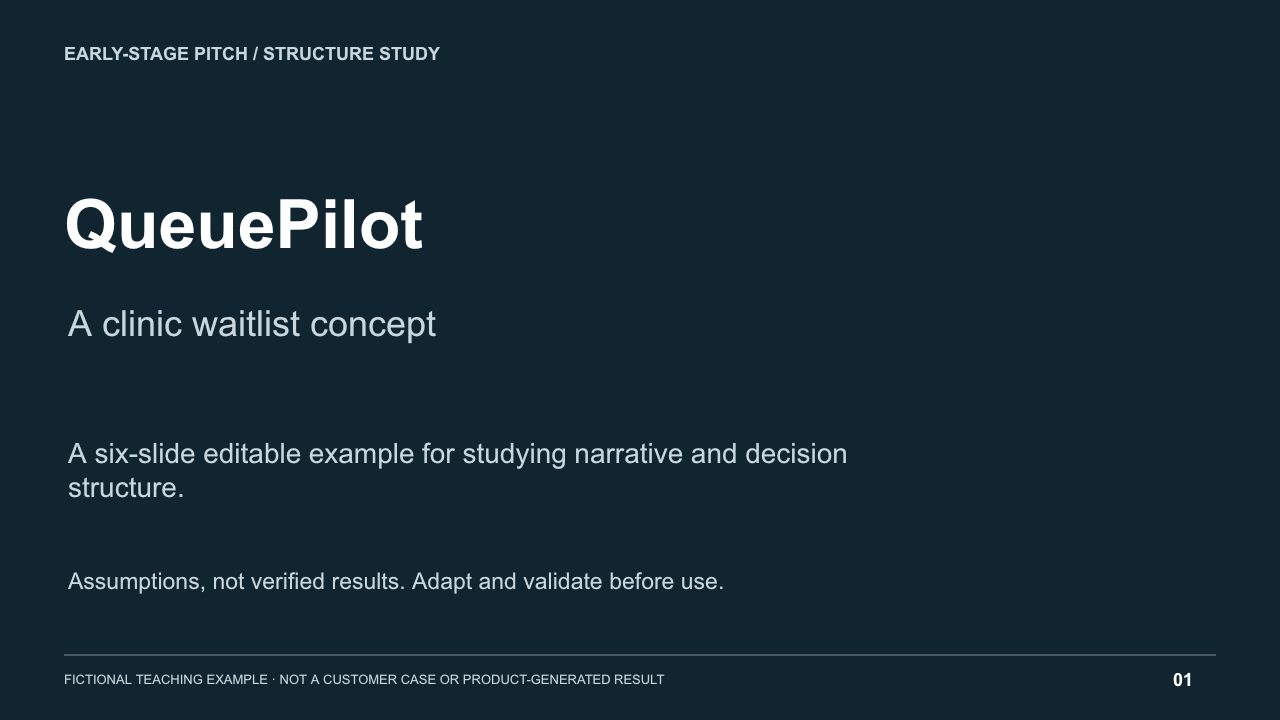
  1. QueuePilot — Slide 1

    Slide 1 — QueuePilot

    The cover identifies the fictional scenario and the purpose of the six-slide study.

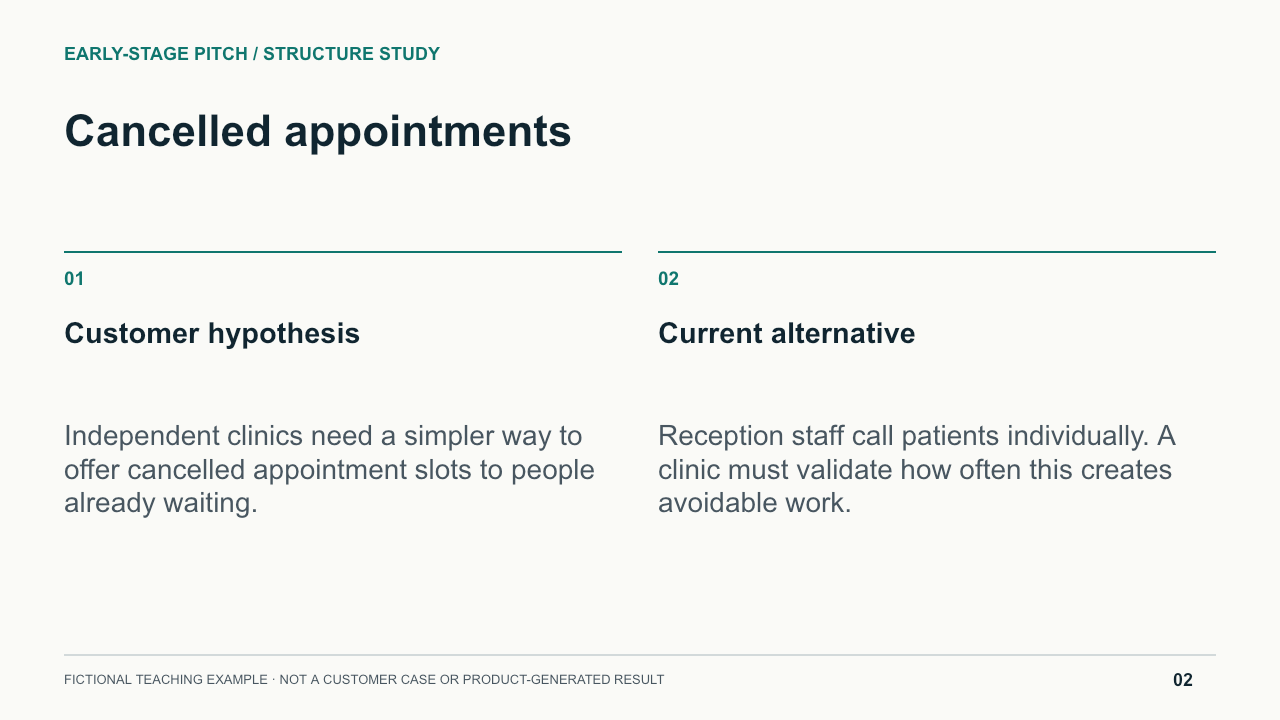
  2. QueuePilot — Slide 2

    Slide 2 — Cancelled appointments

    This slide identifies a customer and a problem hypothesis without inventing a market statistic.

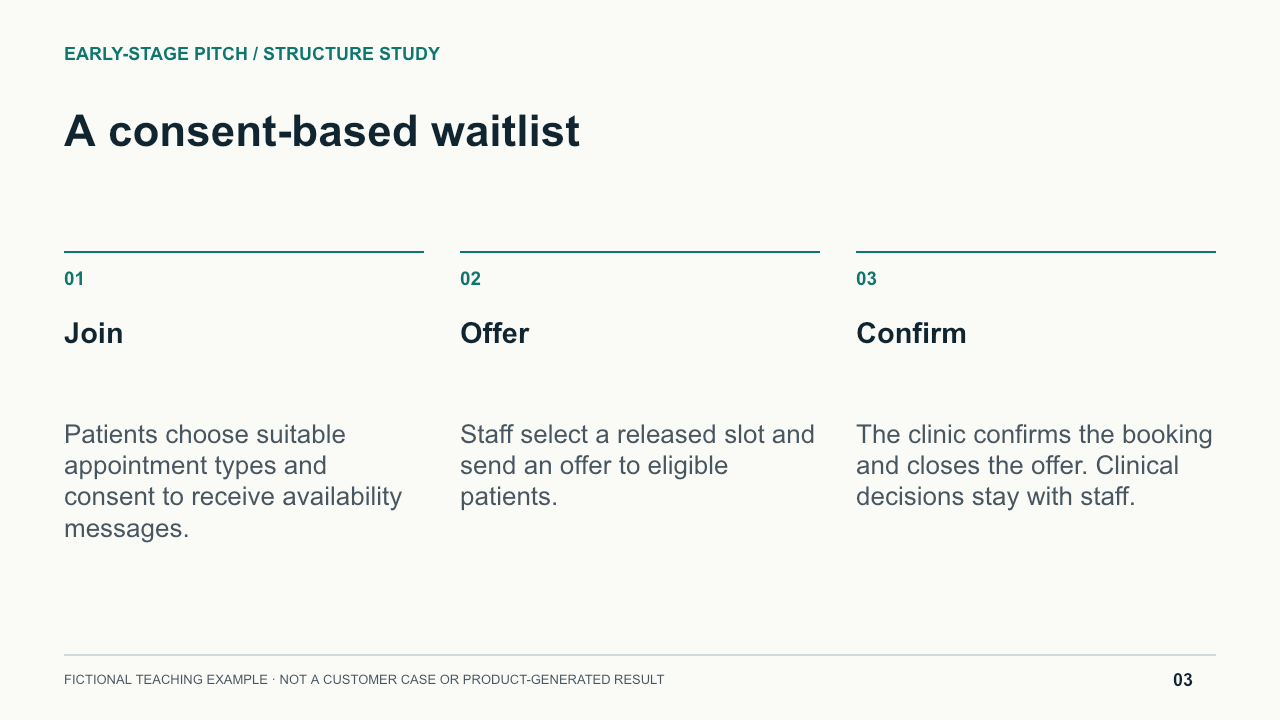
  3. QueuePilot — Slide 3

    Slide 3 — A consent-based waitlist

    A short workflow explains the product. It does not claim that an integration already exists.

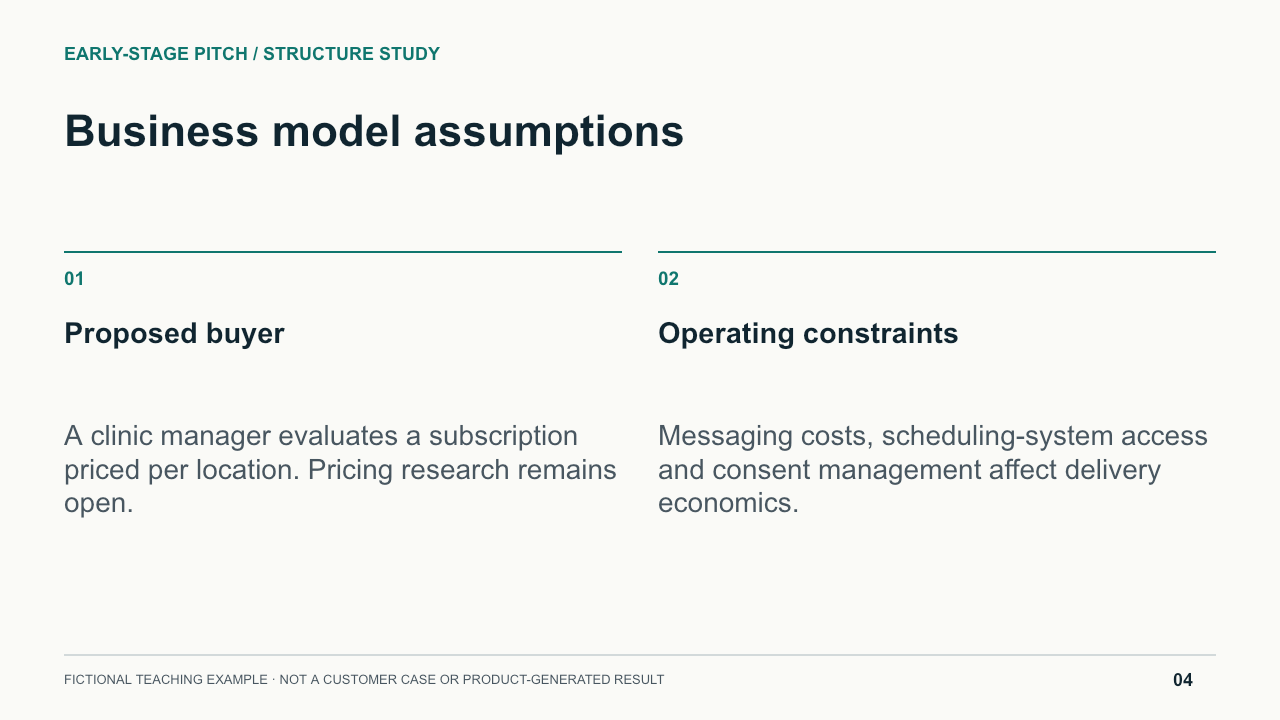
  4. QueuePilot — Slide 4

    Slide 4 — Business model assumptions

    The business model remains an assumption until customer and cost research supports it.

  5. QueuePilot — Slide 5

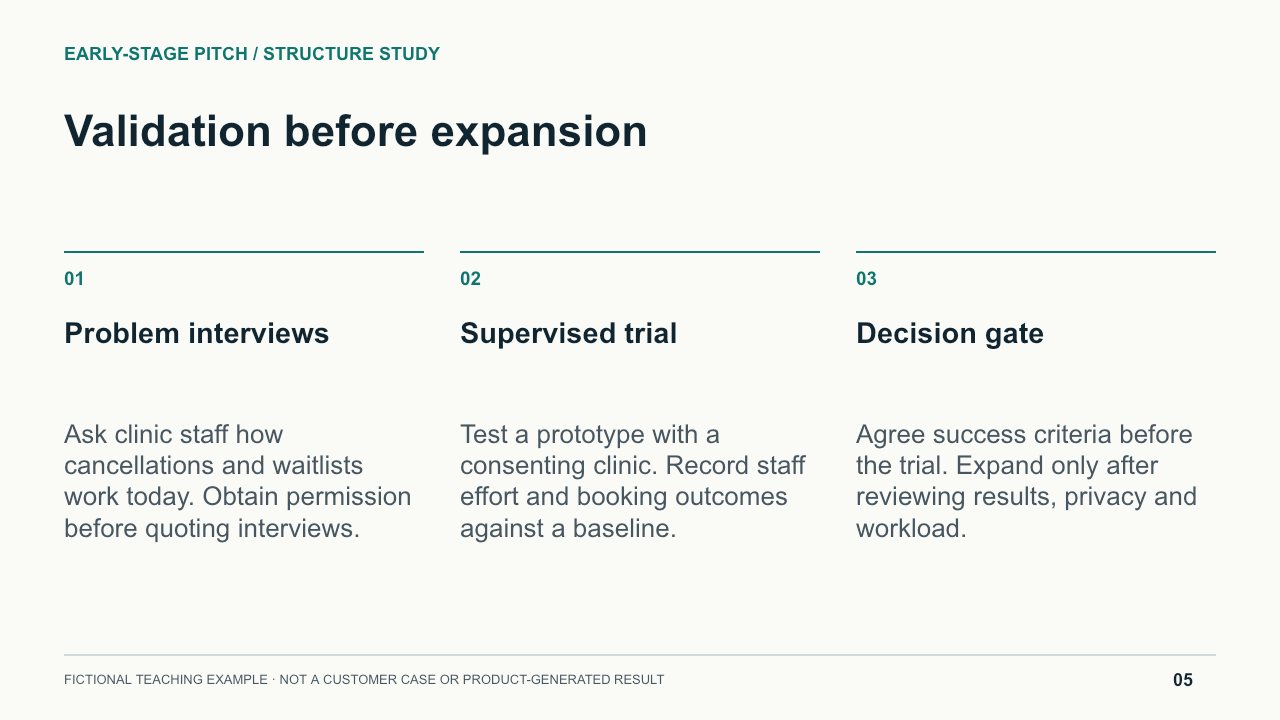
    Slide 5 — Validation before expansion

    This is a validation plan, not fabricated traction or a completed pilot.

  6. QueuePilot — Slide 6

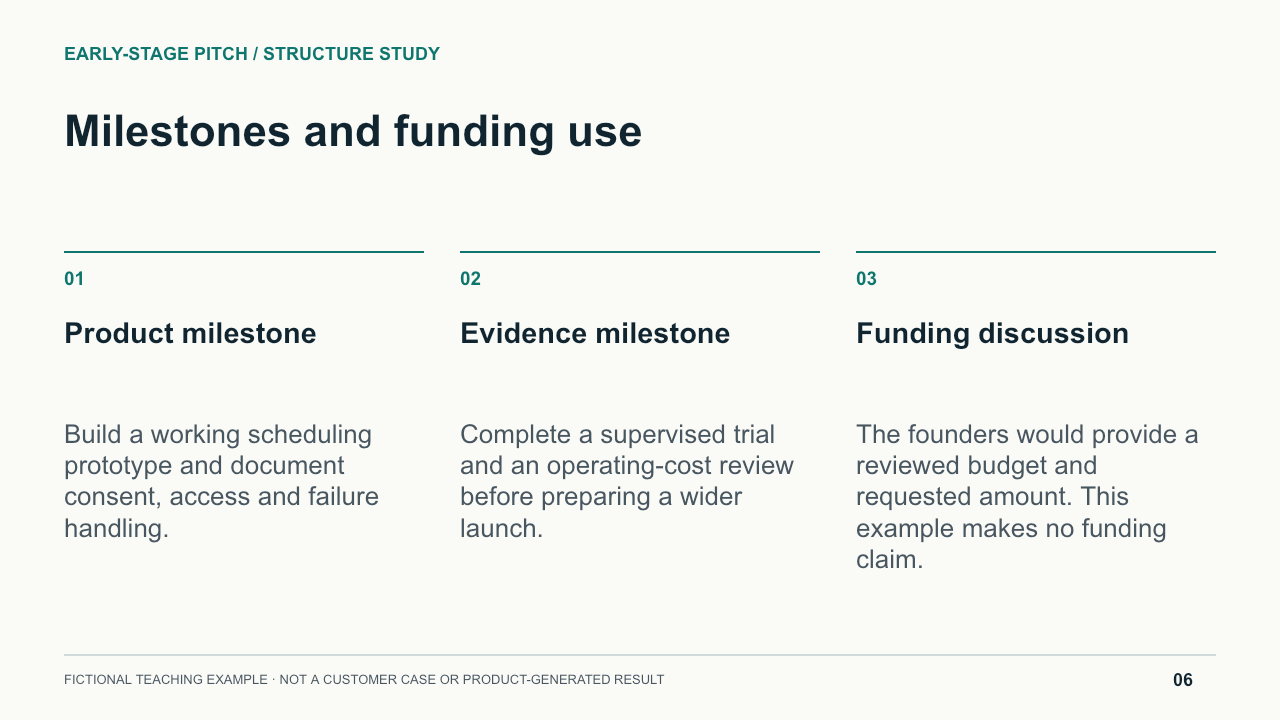
    Slide 6 — Milestones and funding use

    The funding discussion connects resources to evidence and product milestones without inventing a valuation.

RefillRoute

A reusable packaging service concept

Fictional teaching example—not a customer case or product-generated result

File language: English · 6 slides · Free download

Download editable PPTX · PPTX

Preview every slide and its purpose

  1. RefillRoute — Slide 1

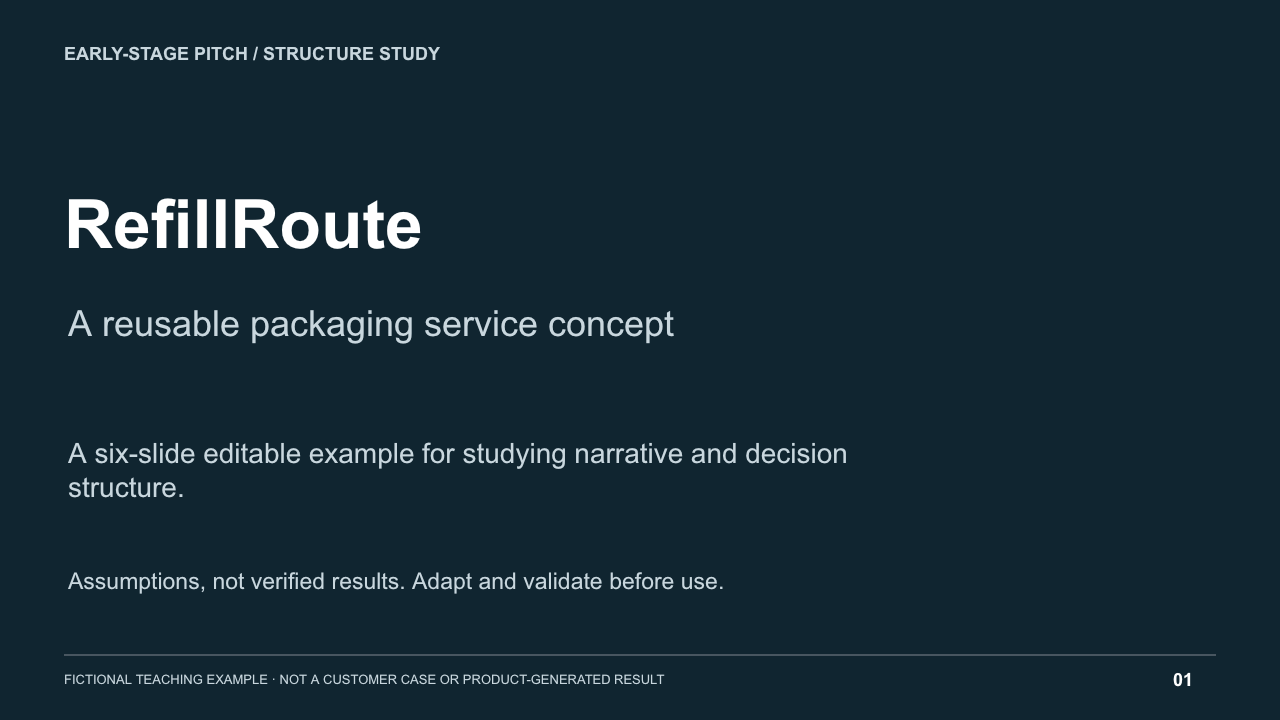
    Slide 1 — RefillRoute

    The cover identifies the fictional scenario and the purpose of the six-slide study.

  2. RefillRoute — Slide 2

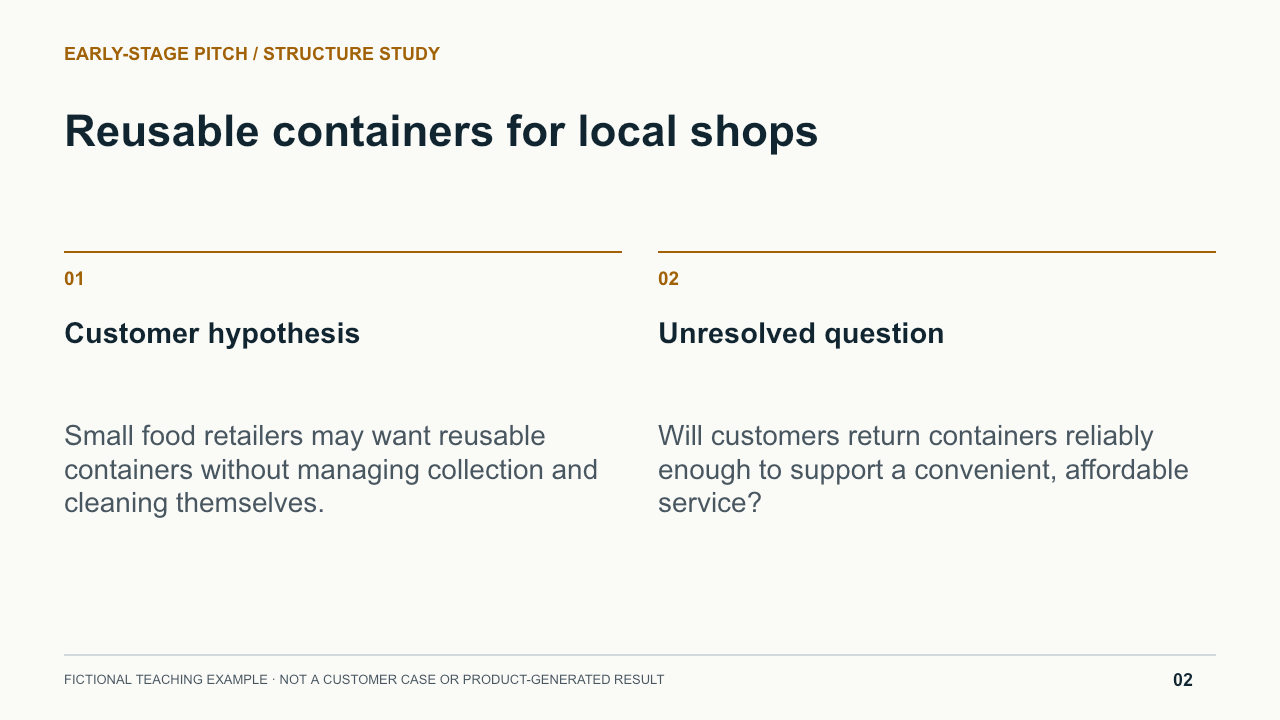
    Slide 2 — Reusable containers for local shops

    A physical-service pitch needs to expose operational uncertainty, not just describe an appealing mission.

  3. RefillRoute — Slide 3

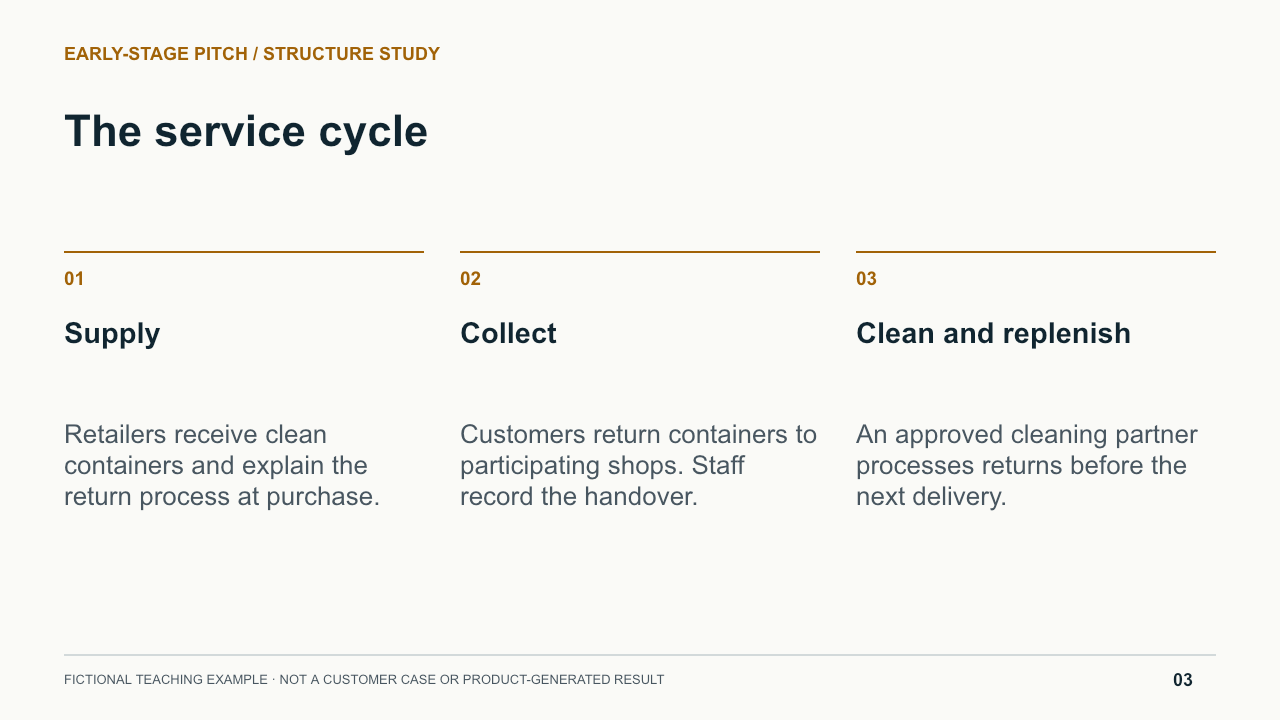
    Slide 3 — The service cycle

    The service cycle makes partner responsibilities visible. It is a proposed operating model.

  4. RefillRoute — Slide 4

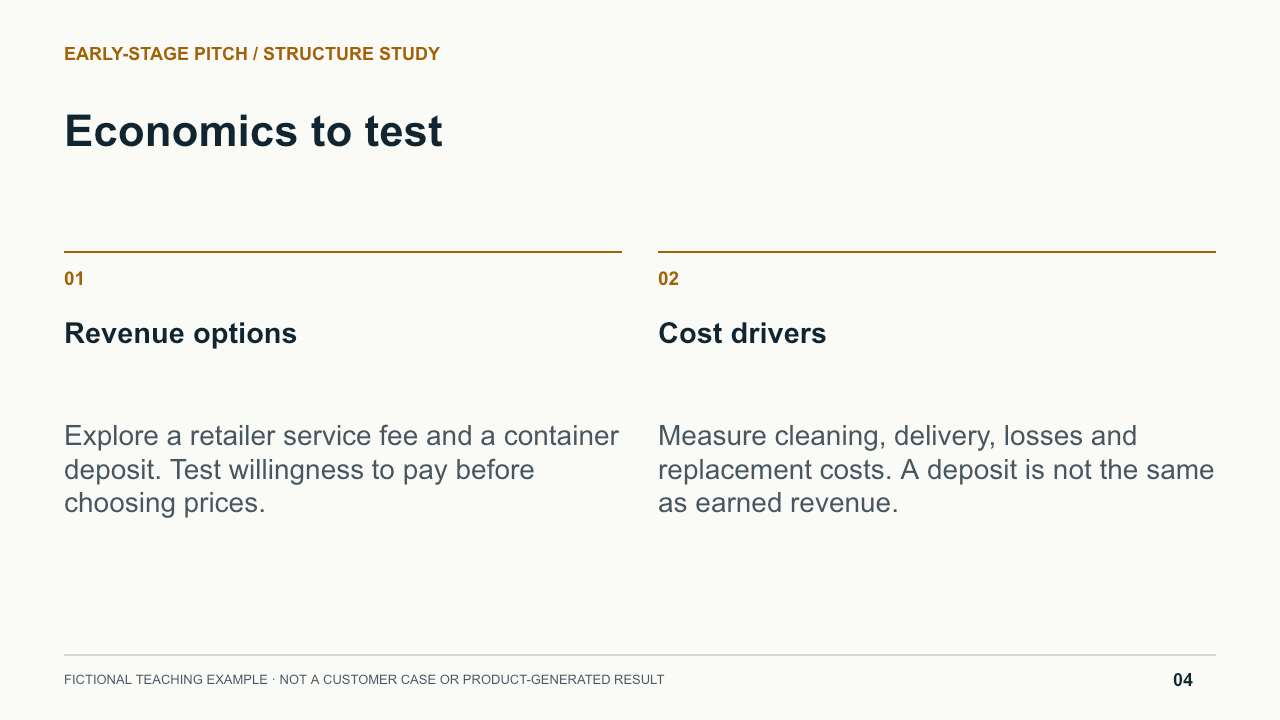
    Slide 4 — Economics to test

    Describe the drivers of unit economics before inserting unsupported margin projections.

  5. RefillRoute — Slide 5

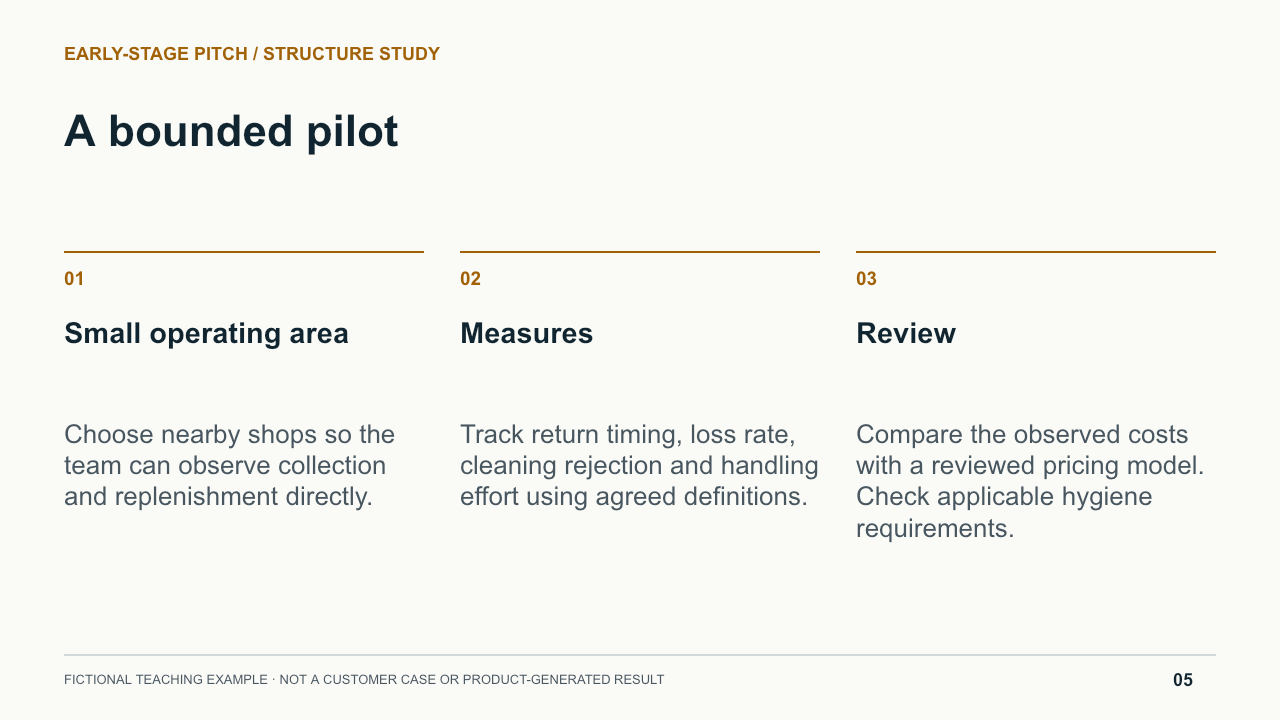
    Slide 5 — A bounded pilot

    The pilot measures service feasibility. No environmental savings or commercial results are asserted.

  6. RefillRoute — Slide 6

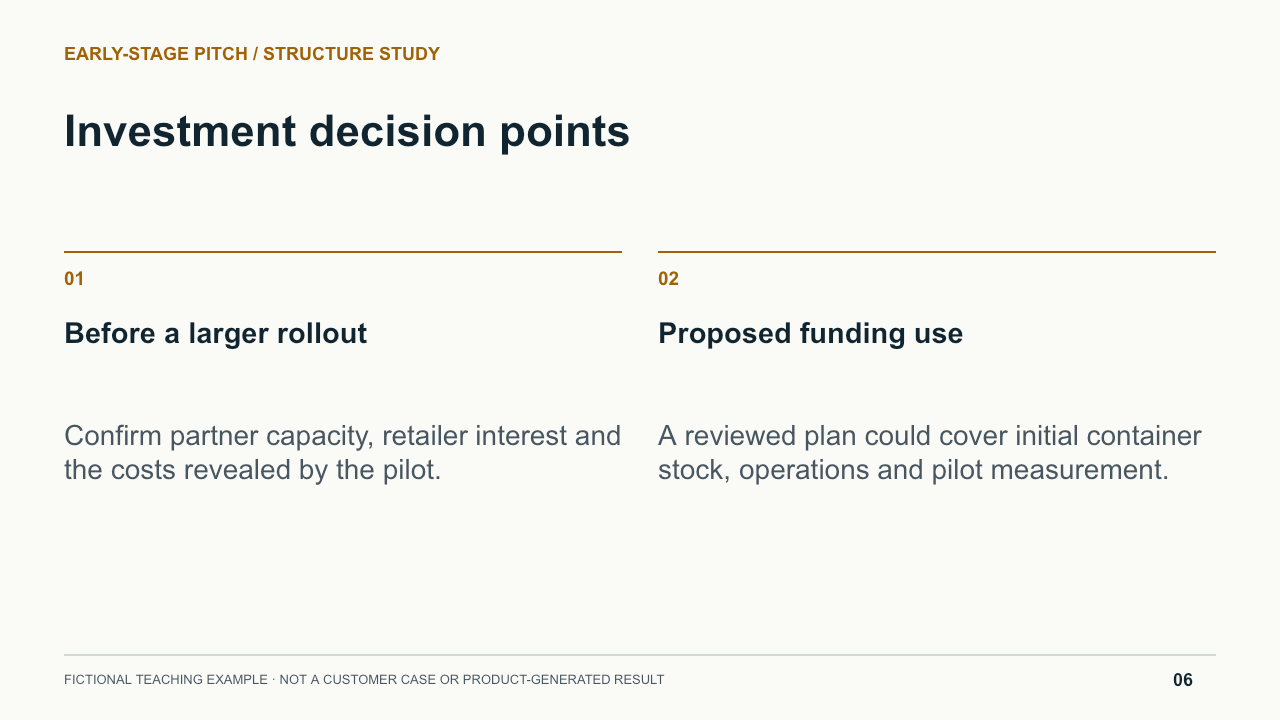
    Slide 6 — Investment decision points

    The closing slide states what evidence an investment discussion still needs, rather than promising returns.

BenchSignal

An equipment-planning software concept

Fictional teaching example—not a customer case or product-generated result

File language: English · 6 slides · Free download

Download editable PPTX · PPTX

Preview every slide and its purpose

  1. BenchSignal — Slide 1

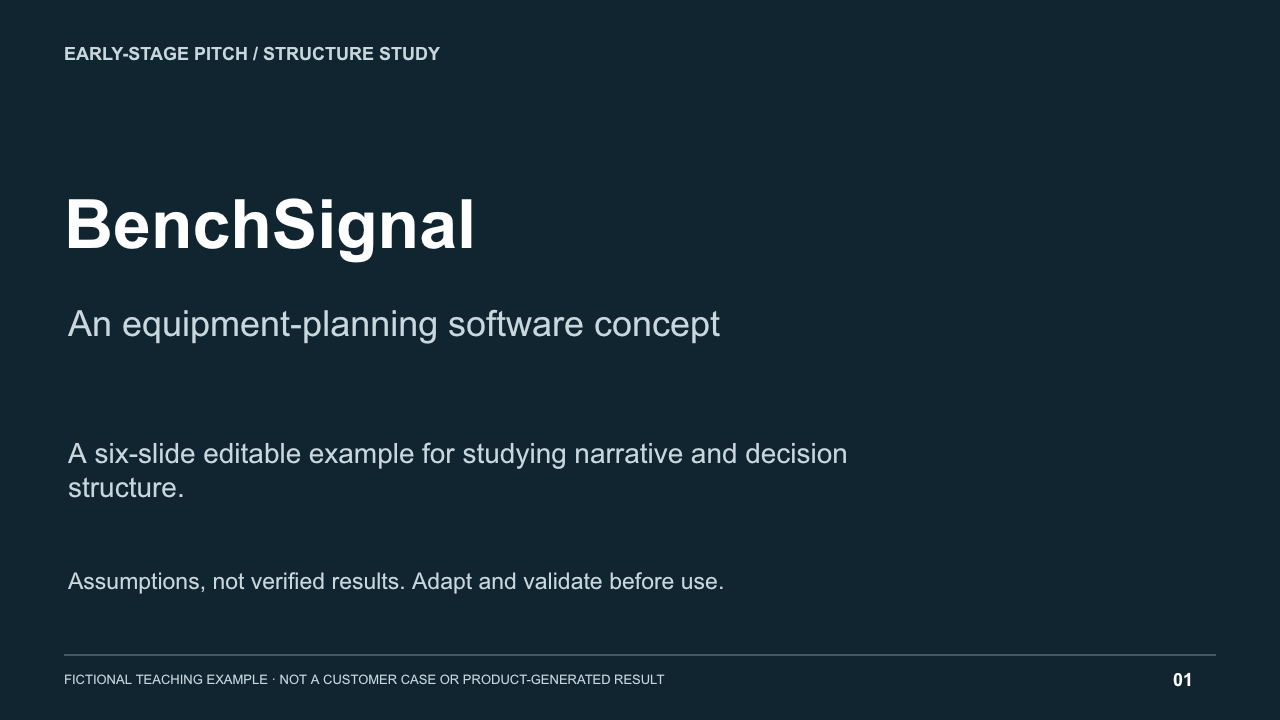
    Slide 1 — BenchSignal

    The cover identifies the fictional scenario and the purpose of the six-slide study.

  2. BenchSignal — Slide 2

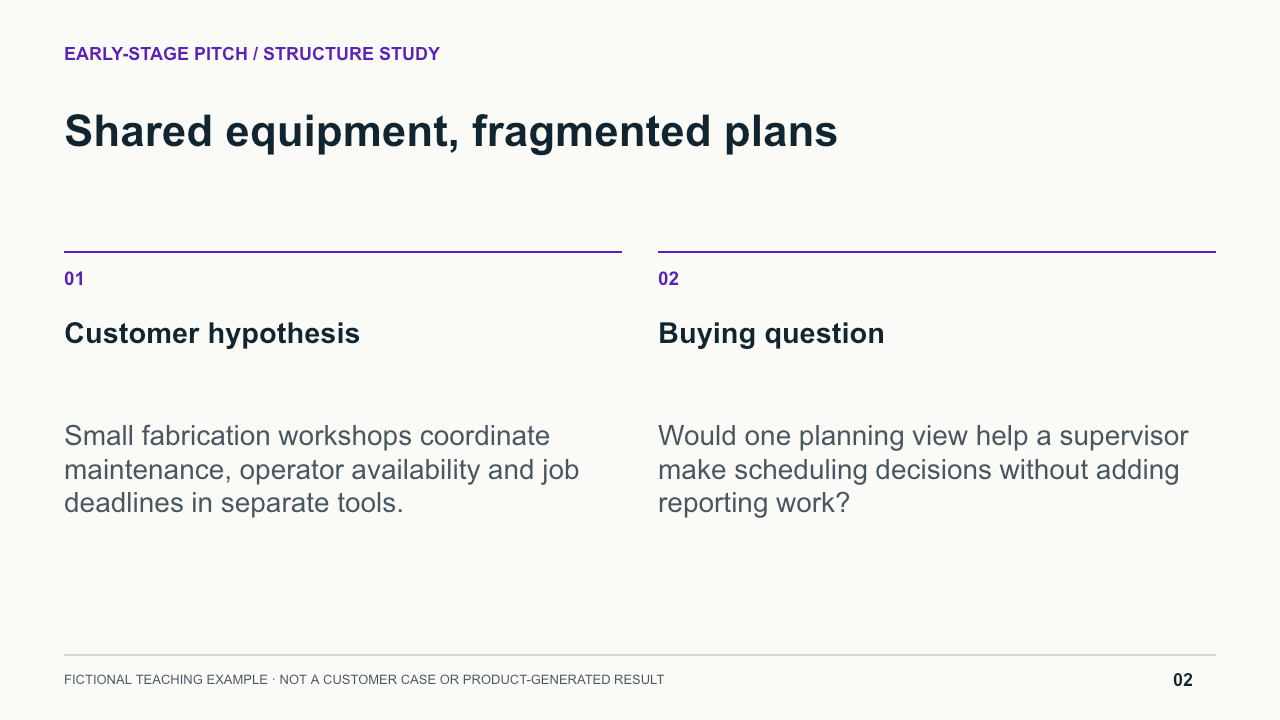
    Slide 2 — Shared equipment, fragmented plans

    The problem is a decision made by a specific buyer, not an unsupported industry-wide productivity claim.

  3. BenchSignal — Slide 3

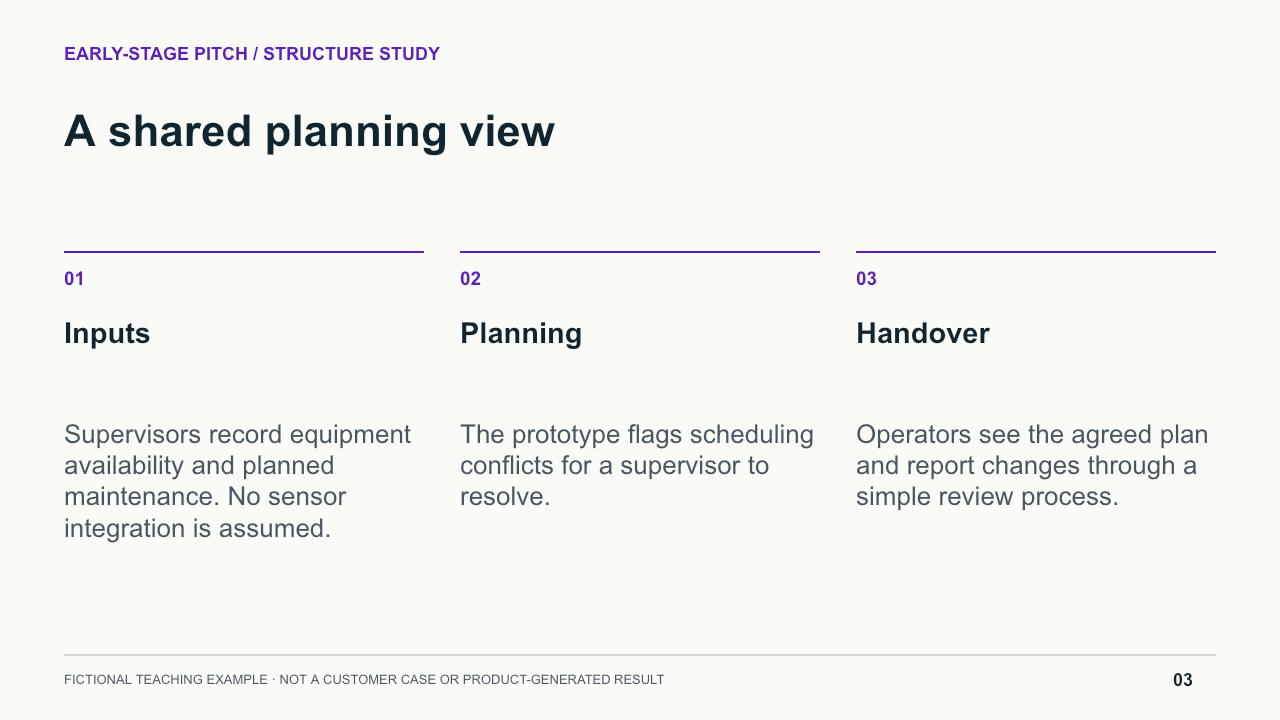
    Slide 3 — A shared planning view

    A software concept can explain its input and decision boundary without inventing automation capabilities.

  4. BenchSignal — Slide 4

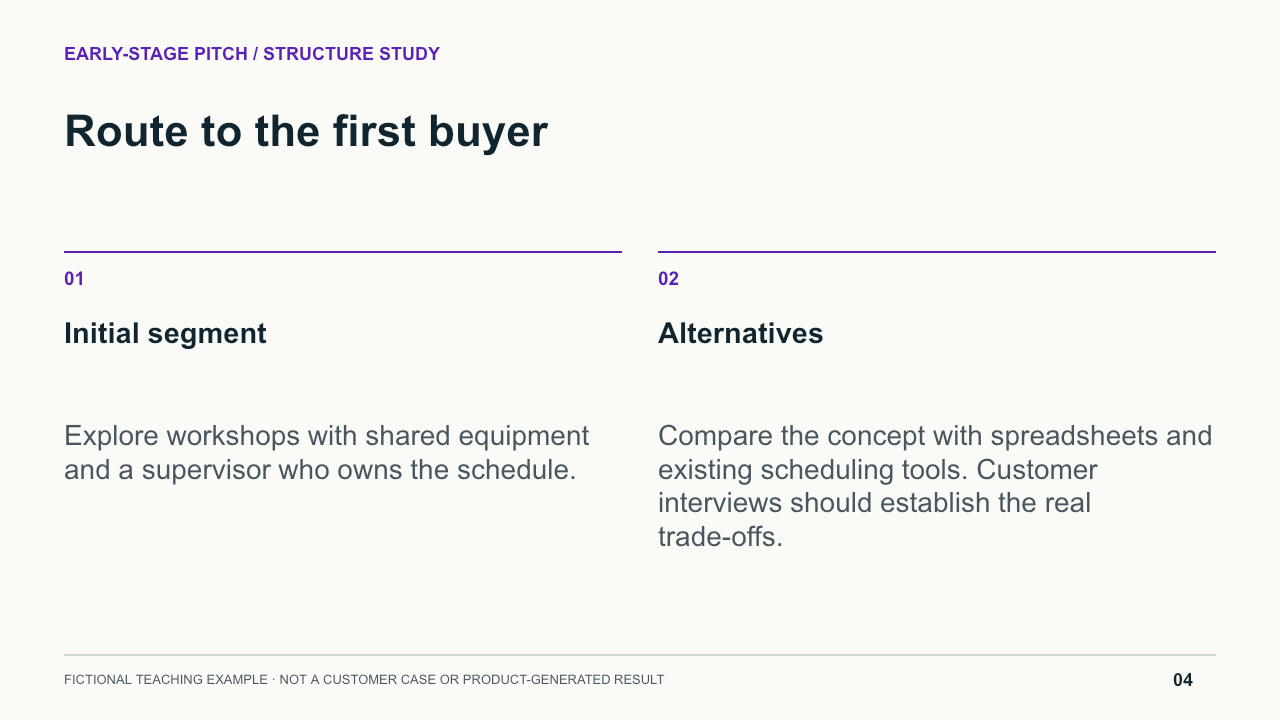
    Slide 4 — Route to the first buyer

    A focused initial segment is more useful than an unverified large market-size claim.

  5. BenchSignal — Slide 5

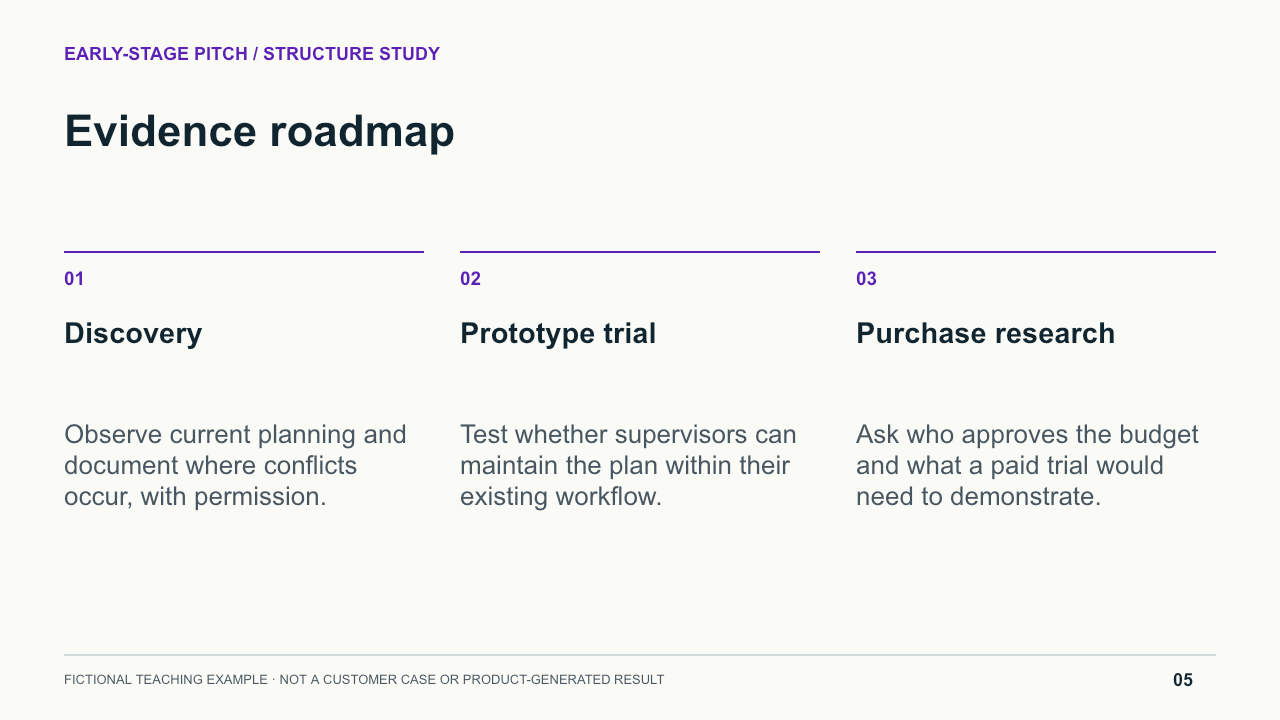
    Slide 5 — Evidence roadmap

    The roadmap separates usability evidence from willingness to pay.

  6. BenchSignal — Slide 6

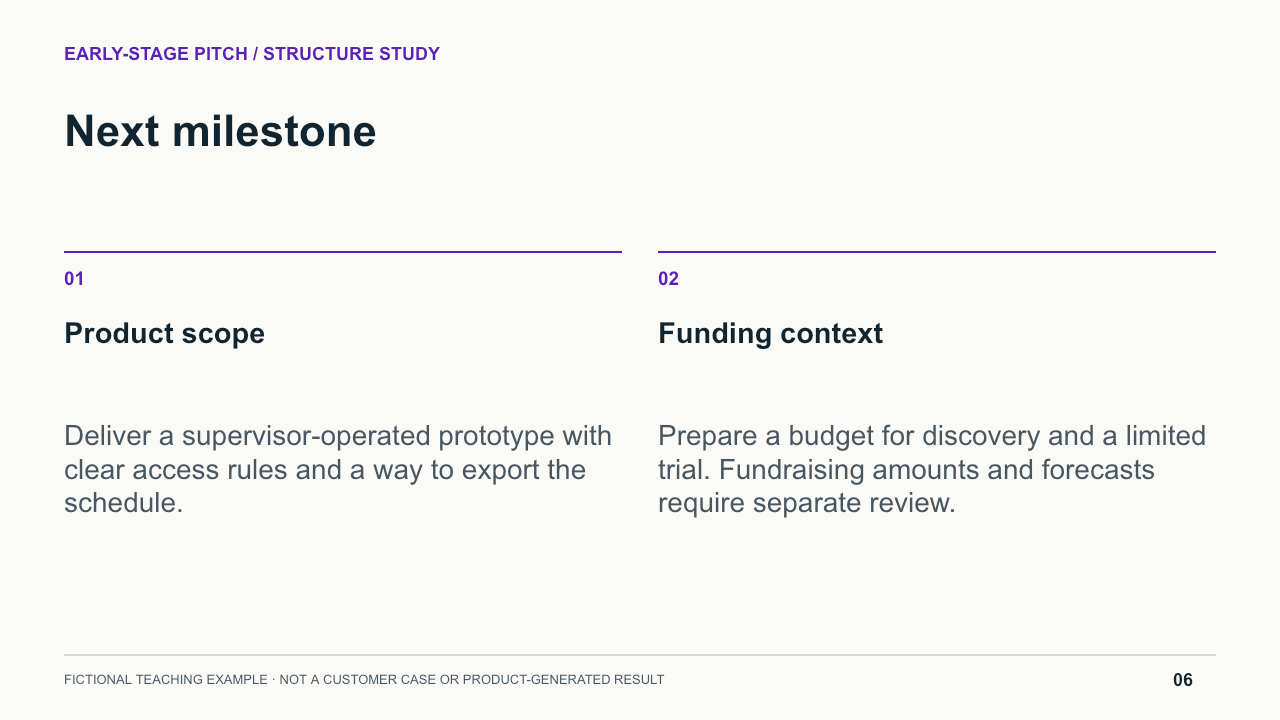
    Slide 6 — Next milestone

    A credible early-stage close can focus on the next testable milestone rather than fictional traction.

Prepare the evidence your real pitch needs

Replace each hypothesis with your current knowledge and clearly label what is still untested. Add source-backed market analysis, permitted customer evidence, a reviewed financial model and a specific funding request only when you have them. These short studies are not an exhaustive fundraising checklist or investment advice.

Reuse: you may download and adapt these teaching assets for personal or commercial presentations. Do not present the fictional scenarios as real customer evidence or verified results. No third-party endorsement is implied.

Questions about these examples

Are six slides enough for a real investor pitch?

Not necessarily. These are compact teaching studies, not a universal slide-count recommendation. A real deck may need team, competition, market, financial and other materials appropriate to the audience and stage.

Why are market-size and traction charts absent?

The fictional scenarios have no supporting research or customer results. The examples explain how to frame evidence gaps rather than inserting fabricated numbers.

Will following these examples help me raise funding?

They can help you examine narrative structure, but no outcome is promised. Investment decisions depend on the business, evidence, team, terms and investor context.